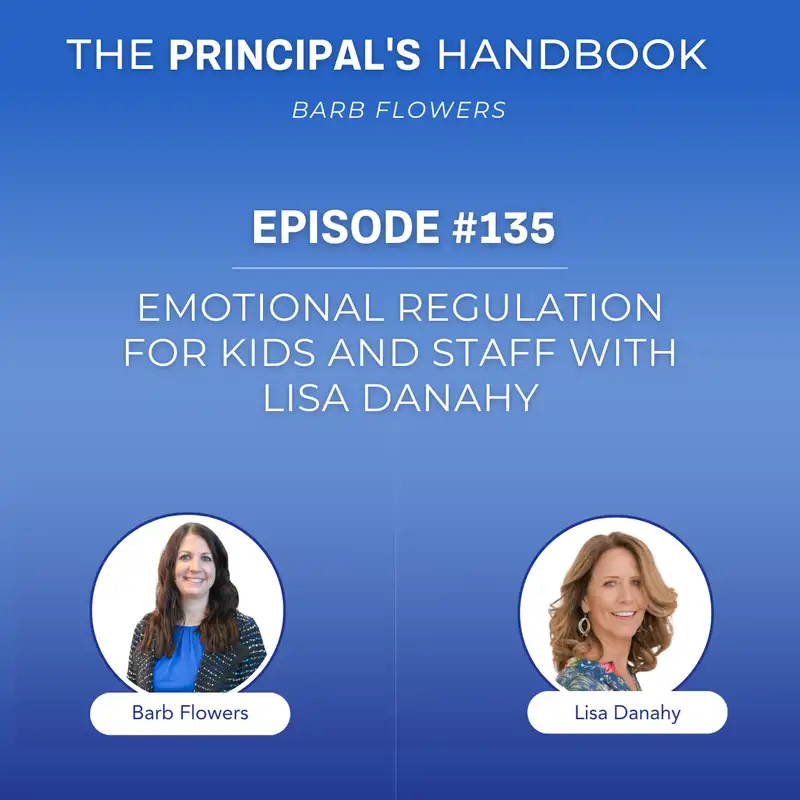
Emotional Regulation for Kids and Staff with Lisa Danahy
Emotional Regulation for Kids and Staff with Lisa Danahy
===
[00:00:00] Welcome to the Principal's Handbook, your go-to resource for principals looking to revamp their leadership approach and prioritize self-care. I'm Barb Flowers, a certified life coach with eight years of experience as an elementary principal. Tune in each week as we delve into strategies for boosting mental resilience, managing time effectively, and nurturing overall wellness.
From tackling daily challenges to maintaining a healthy work-life balance. We'll navigate the complexities of school leadership together. Join me in fostering your sense of purpose as a principal and reigniting your passion for the job. Welcome to a podcast where your wellbeing is the top priority. I.
Audio Only - All Participants: welcome everyone to the podcast. , I'm really excited today because we have a special guest with us. We have Lisa dhe, who is the founder of Create Calm . , Owner of Radiant Child Yoga, and author of Creating Calm in Your Classroom. A nationally recognized speaker and international trainer.
Lisa brings over 30 years [00:01:00] of experience as a yoga therapist and educator blending mindfulness, neuroscience, and practical classroom strategies. She's known as laughing Lisa. She's love for her warmth, clarity, and ability to equip educators with simple evidence-based tools that foster calm connection and confidence in even the most challenging environments.
So welcome, Lisa. I'm so excited to have you on today. Thank you. I am super excited to be here with you. This is like the perfect topic for this podcast. All of these things. As I'm reading your background, I'm like, you are the perfect fit for this podcast. So talk to us. I went over your biography shortly, but talk to us a little bit about how you got here and your experiences in education.
Sure. , It goes back a few years. , I actually, , was in human resources and management, kind of more typical corporate,. Environments. I was, I worked at a large [00:02:00] law firm, got, , married and had , and as my kids were in their childcare center, , I was on the board of directors there and offering to help with human resource policies, curriculum writing.
I had a background in psychology and, . Eventually I was put in charge of finding a new director for the school and I couldn't find one. And so in considering what ways I felt like I could contribute to management and, , organizational tools for another organization that benefited my children and how I could spend more time with my kids, I went to run this preschool and, , I spent 20 years there.
I share a lot of, , comradery in your stories of, you know, being in the trenches as principal because,, I knew that we needed to accomplish academics, but I also knew that we needed to build , this capacity for children to live well and fully and [00:03:00] to love learning, , and , to build community.
, And I really struggled sometimes at keeping that balance. And, , and it was a really stressful job. It was really hard to turn it off. Yeah. , It was all the things you often talk about. It was so challenging to, , to know where to draw lines of what. You know where I took home, what I left at work.
So I started doing yoga and practicing meditation as a self-help skill. And then I started noticing that when things got a little heated at school, especially when we had behavior challenges or teachers were having a hard time, I noticed that I could use some of these skills and by regulating myself, it was impacting.
Everyone else in the school. So I started to build a curriculum and a culture around social emotional learning back in the nineties. Yeah. And [00:04:00] you know, , and it was pretty unusual back then, but it was fascinating to me because as I did more training and I'm now , a registered yoga therapist, but as I did more training in this notion of.
My energy is what I can control and my energy impacts everyone else. Everything else started to click and we started to have a much more cohesive collaborative school environment. Folks were feeling much more confident and comfortable. , Parents and teachers felt more in sync and children were laughing and having more fun.
Yeah. Yeah, it makes a huge difference how we regulate ourselves and how we show up. , So I wanna start by talking about when we look at student behavior through a nervous system lens, and like you're talking about the SEL, how kids are regulating themselves. What do you think most school [00:05:00] leaders misunderstand or overlook?
, I think that. If I were to boil it down, I love the talk about the science, but if I were to boil it down, , the nervous system is the entry point into. Controlling our bodies, controlling our feelings, controlling our thoughts. And controlling is not the word I really wanna use, but it's the word that most people understand in accessing, and I think there's an illusion about how difficult that is.
Once you can understand that there's an activating and a calming side of your nervous system, and you know how to tap into those instantly. You become much more a creator of your experience. And the easiest way to tap into that is something that we all have [00:06:00] access to all the time, and we very, very rarely tap into it.
And that is the breath. Mm-hmm. Every inhale, I'm activating every exhale. I'm relaxing. So naturally the body is breathing in and breathing out, trying to. Become more activated, become more relaxed. And that's our mechanism for balancing. And if I can start to be aware of my breath, I can start to be aware of my energetic states.
And in that I can start to have more, , say in my reactivity or my receptivity. , And I think we underestimate the simplicity of it. Yeah, and it's one of those things, right? , I kind of relate it to , we know eating healthy is so important and good for us. But we overcomplicate it. If we wanna lose weight , we really can overcomplicate it.
And I'm guilty of that, but it's the same, I think about this of being stressed or [00:07:00] even when I'm dealing with a student and it can be really hard sometimes , and I have to watch myself and, get to a calm state, like you said. So I don't make any like decisions that I wouldn't wanna make or when I'm calling a parent.
And we forget how simple it is to just stop and take a couple breaths. We do, and , I think sometimes too, we want so much to change what we're seeing, but instead, I think if we can meet what we're seeing energetically, then we. We create a bond like co-regulation. We create a co-existence within whatever that energy is.
Whether that student is super, super hyper, or super, super withdrawn. If I go to where they are without any judgment or a lot of talk and I meet them there, then as we move the energy together, we now are creating a safe space for both of us to engage in those next steps. And it all starts with breath.
Well, and as you're talking about that, I'm thinking about [00:08:00] one other topic. You know, obviously students, I hear this a lot with, right? , Emotional regulation with students, but also staff. One of the hardest things I think as a principal is navigating. I say I have navigated through some of the hardest situations with staff through diagnosis and divorces and, you know, just all the life circumstances that staff go through.
And we go through as leaders and we're there together. And so there's a lot of emotions happening in the building. So speak to that a little bit when we're thinking about the same idea with staff. Absolutely, because I, and , I think this is a key part , of what might be contributing to the increase in burnout lately, burnout of principals, burnout of teachers is that, , we all , are pretty emotionally volatile because we're not getting enough rest.
We're not having enough quiet time. We're not having enough moments of self-regulation. So we're all, this. Energy bouncing off of each [00:09:00] other. And so , as a school administrator, if I can recognize, oh, here, I'll give you an example. And I know , you've had this, maybe your listeners have too.
Where I come into school in the morning, I'm feeling feeling pretty good. I have decent night's sleep. , I feel like I'm coping. I'm relatively happy, and I walk into a classroom and the teacher is yelling or. Kids are crying or there's just this like blah, right? And , so I can do one of two things.
I can conform, I can add to the chaos, or I can be the regulating state. And I can do that almost more effectively with the adult because they. They're going to, it's gonna be such a contrast to them, right? Yeah. So if I come in and an adult is dysregulated, I wanna meet them where they are. I [00:10:00] can't expect a dysregulated person, adult, or child to, to regulate on their own, or they would have.
Right. I can't expect them to follow my words. , My favorite thing is when someone says, just calm down. You need to relax. What happens when I say, you need to relax? . I'm thinking when my husband says that. Right? , It's even worse. , Don't tell me to relax. I'm fine. Don't, right. Don't tell me because I'm doing the best I can.
, I'm in this state because I'm not able to relax. So if I can go to. My staff, my colleagues, and say, without any words, just sit with them and, , oh. If I'm, if they're feeling really angry and tense, I can do some movement or some breathing, I can go, I really expressive breath, , or if they're really withdrawn , and, , feeling, feeling low energy.
I'm gonna offer them a really slow entry in right. I'm not [00:11:00] gonna give this big, forceful breath to someone who can't feel themselves breathing. So I think the key is , to be able, within myself. To keep myself, , regulated and observe what the energy state is of the teacher in front of me. It doesn't matter the circumstances, it doesn't matter.
Like you were saying, there's so many things that cause dysregulation, and I don't need to get into the story of it or what's attached to it. I just need to see this individual is dysregulated. How can I hold a steady, safe space? And this gets to your social emotional regulation. How can I be the safe space for them to move their energy and become regulated?
And then we have the conversation about what we're gonna do to fix whatever the situation is. And sometimes the entire situation diffuses when we have come to a regulated state. Yeah, and , I [00:12:00] found a lot, and I'm sure you have in your experience too, and I'm thinking about parents, parents come in so upset , and the number one thing that kind of helps them calm down is just being that calm space to listen.
Just being that like sounding board for them to listen and that's all they need to kind of bring them down. Absolutely. Absolutely. And, sometimes I'll, even with parents give 'em the opportunity to stomp their feet or, engage in some playful movement to really express themselves.
, And that's where I have squishy toys and I have things that, , you can make contact with. I might even do some body tapping or some. Hand rubbing. , And I know that sounds a little bit, , unorthodox or unfamiliar, but it makes a big difference if if I sit there and say, all right, before we get started, rub your hands together.
Let's rub, rub, rub, rub, rub, rub, rub. Now reach your arms out. Take a big breath in, stretch 'em out and say, [00:13:00] oh, now tell me why you're here. Mm-hmm. Yeah, I did some positive intelligence coaching, and that's what he talked a lot about. If you're familiar, the PQ reps of just being in the moment, when you're nervous, touch your fingertips, rub, you know your hands on your legs, just to get yourself grounded into the present moment.
And then you're not focused on the future or the past. You're in the moment right now. , And what that does from a regulatory perspective is when I put my hands on my thighs or I rub my arms or I touch my fingers, I'm becoming connected to my physiology when I do that. I'm more likely to pay attention to the signs of the tense muscles, the short breathing, the compression of the chest, the other physiological signs of dysregulation.
And I'm quicker to, to notice and say, oh, maybe I need a breath [00:14:00] and give myself. , The opportunity to receive the feedback so that I can be in a little bit more regulated state and that benefits everyone because if I offer you a chance to dis to Reregulate, that's gonna offer me a chance to reregulate, right?
Yeah, they would always, we would talk about that in coaching when coaching a client. We would take them through PQ sessions, but really it's, you know, benefiting us too as the coach that we get to take that minute and take a breath. , how do you think principals can create calmer, more regulated school environments without lowering expectations or accountability?
And I think about this. All the time. For example, I'm in a low income district, , kindergarten, first and second grade building. And so a lot of kindergartners come in and they don't know how to regulate emotions or. , Things like that. So we talk a lot about, let's take time for social emotional learning.
Let that needs to be a huge chunk of our day at the beginning of [00:15:00] kindergarten as they're getting used to school. But then there's also all the accountability with academics and all of the things that we have to get done. So how do you kind of balance that as a school leader? So that's been, , one of my proudest accomplishments is recognizing that there is no more room in the day for anything else.
Mm-hmm. And yet, mm-hmm. Um, we've gotta find time for the social emotional regulation. And so what I've done is, , and that's actually at the core of the practices in my book, is I've created a set of movements, breathing and, , mindfulness exercises that can be done as standalone pieces or in sequences as transition tools.
As entry points into academic times as transition to specials, as, opener to, , morning circle or morning meeting as the closing to the end of the day. [00:16:00] So instead of having big chunks of time that are allocated to developing these tools, what we're doing is very playfully, very subtly. Practicing them and engaging them in the normal routine.
So one big example is for kindergartners. You mentioned your kindergartners coming in for kindergarten teachers. What we work on is creating class agreements, but class agreements a little bit different than you might expect. Each of our class agreements is maybe one or two words, and it comes with a movement.
So when I'm teaching, when I'm leading an exercise for anybody, my two class agreements are love and listen. So love I give this motion of wrapping your arms around yourself and then spreading your arms open and receiving. , So it's this extending, expanding and receiving. So as you're opening and closing your arms, you're sharing kindness, you're sharing respect, [00:17:00] physiologically, you're also.
Tuning into proprioceptive space, you're also tuning into the physical body. You're moving energy. So that love movement helps. As a reminder of where I am physically, the listen, we rub the tops of our ears or the acupressure points that activate , the mind to focus and the body to be clear. So we listen, who are we gonna listen to?
We're gonna listen to each other, our teachers, ourselves. But what really happens then is we're practicing that every morning as part of our morning meeting. But the real nugget comes when the children start and the teachers start to naturally engage in those exercises throughout the day. And I will inevitably see a teacher rub their ear.
, And send a sign to a student without saying a word. Oh, are you listening? And it may imply that their behavior is getting a little dysregulated or you know, and then they rub their ear [00:18:00] and that the child gets it. Oh yeah, I need to tune into myself or. Am I occupying too big or too little a space? If I, as a teacher wrap my hands around myself, I don't have to say a word that sends a message, here's the tool that you might wanna use right now.
So we, we play with them and practice them without needing to use them right away. And this is the important part. They have to be a natural part of the routine so that in the crisis we can access 'em. I love that because we've actually been talking about social emotional curriculums and things like that, and the problem I have, and even in my last school, the counselor did great whole group lessons, but her and I would always talk.
If there's not carryover, there's no point of doing it. And so I love what you're saying, that it's in the transitions, it's in the reminders. It's. All throughout the day, because we've talked about do we make it a special, like how do we do it? [00:19:00] But I'm like, if the teachers aren't teaching it, it's not going to really impact kids.
Yeah, I've had a teacher once, , she was having, , she had a really large class and, , she's having some behavior regulation issues, so I went in to observe and, , we went to the playground together and the kids were all on the playground and she was lining the kids up to come back in. And as most of us have experienced.
It was a disaster. No, , half the kids weren't coming, the other half were sitting there, you know, eating rocks and, and so it was just very chaotic. And I said, can I try something? And she said, sure. And she said, this is the worst part, once I have 'em corralled, is getting back to the classroom and having any hope of, , some sort of.
Reduction in chaos. And so I said, let me give a try to something. So we walked together into the hallway and I stood them in the hallway and we turned around to the wall and I had them place their hands on the wall, give heavy pressure with [00:20:00] their hands and bend forward and. And in, , mindful movement, this might be similar to like a down dog, just to give you a visual, right.
, Yeah, you're arching forward, so you're pressing into the wall, and I had them take five breaths like that. Then I had them turn around and have their backs on the wall and press their elbows into the wall. So there was this heavy pressure standing really tall, pushing into their feet, pushing into their elbows, and then they brought their hands together and rubbed.
We rubbed their hands to, , activate their nervous system. We put their hands out in front of them and I said, imagine you're holding something very special and delicate. They put it in their hands and the whole time we're doing this really, , beautiful collaborative breathing. Then I have them line up and we walk together to their classroom.
They take a collective breath together. As we walk in, they find their seats. The teacher said. She couldn't believe the [00:21:00] shift in the energy and the attention. She also felt like the children were happier because they had been productively guided through this really tumultuous, yeah. Everybody else in the hallway was screaming and carrying on, and we, here, we were walking, carrying our treasures.
And , the fascinating part is. We only did that once together. She tried it the next day. The children were longing for it. They insisted out on the playground, can we do this? Are we gonna do our special lineup? And she did it every day. And other teachers started to notice. And say, what are you doing?
What's going on? When you all are so quiet, you all are so connected, and so you're right. It's really important that it be just a part of our being. And that comes in a couple different ways. We do have to practice it as teachers. Before we can teach it and Right. We, you know, and , that's a challenge.
, We need to [00:22:00] be doing these practices in our daily lives. We need to be managing our energy. On our own and understanding what these tools do for us, and then we can start to bring them, , and that comes through trainings. That's one of the big things I do is I go into a whole school and we do a training on these tools so that the teachers are understanding the neuroscience, they're understanding the why.
Then we look at the how, and then we go in and we start implementing. Let me ask you this, because this has been a huge discussion with kindergarten, but I'm sure any elementary principal, and sorry, principals if you're not elementary, but a big thing in the building with YouTube and smart boards is to do brain breaks where they're getting up and they're.
You know, dancing and all of this stuff, and I had a conversation with a kindergarten teacher that, , in my opinion, it looks like it's amping kids up. I don't think we leave those activities and they really got their energy out or had a [00:23:00] brain break, like we're amping them up. So what is your thoughts in relation to like your nervous system with that?
, You are singing my song, my friend. , I totally agree with you, and I think one of the, , when I made the transition from school administrator to, , creating educational SEL. Mindfulness based educational programs. I recognized that what was out there was doing exactly what you're saying. It was part of the puzzle, not the whole piece.
And so what I did was I developed a, this training around what I call the bell-shaped curve of energy. So when we are engaging in any kind of brain break or transition. What we're wanting to do is give free expression of the high energy, but we have to have an entry and an exit. So I do have videos and exercises on video that teachers [00:24:00] use, but the difference is they start with breathing.
So we would start with three balloon breaths. If I'm gonna do something super short or super short brain break, we're gonna do three balloon breaths and maybe we're going to. Be a volcano. We're gonna rumble our feet and then jump and spread our lava and get really big and explosive. But then we're gonna do another breath and we're gonna come back down and we're gonna become the slow flow of lava.
And so you can feel that. So we take a couple breaths, we find our mountain. We build and build and build. We explode as the lava. And then we come back and we let the lava flow and cool. And we sit back down. And what I've done there is given the practice of releasing the energy, the actual energy release, to get them refocused, but I brought them to their breath.
I wanna come in with the breath and out with the breath. Or else, like you said, I'm [00:25:00] leaving them behind. Mm-hmm. I had, I wanna share this really interesting quick story. I had a teacher, a kindergarten teacher who. And this, I've seen this in older, , classrooms too. One of our methods of teaching modulation is to do a little sounding and affirmation.
, Usually a four syllable affirmation. And we'll say it at a regular voice. We'll say it at a whisper. We'll let it be quiet inside, and then we walk back out. Well. And I'm guilty of this too. We teachers love it when our kids get quiet, it feels really juicy, but we wanna teach them to go in and out of the quiet.
And I had one teacher one time who insisted that the best part was walking them into the quiet. And she came to one of our community building meetings and she said, I have to tell you all a story. I have this little girl and we were doing our meditation. I am so calm. And we [00:26:00] were whispering, I am so calm.
And then we were silent and we were, I am so calm , and we didn't say anything. And she said, and then I ended it. I couldn't get anyone to do anything. She said they were all still stuck in that silent space. And this one little girl said, you forgot to bring this out.
That's so cute. So, so we forget to bring them out of the high and out of the low, and it's just as, as unproductive. , We need to be conscious as educators that there is an entry and an exit. And , as long as we do that, , then we can use the big energy. And I think the big energy activities are highly purposeful because I don't think we move enough.
But you're right, , we can't leave them there. Right. Right. I like that. I think that's really practical. Well, what do you suggest if school leaders are interested? I know I am. We'll have a conversation after for some [00:27:00] practices that they can use in their school. , How can they connect with you? What are next steps for them?
, I would be happy to connect with anybody on this it, I love to, to share and support you all in, in the very, very complicated challenging, , love filled work that you're doing. , Best place to find me is at my nonprofit create calm.org, and you can find all of our programming. All of you can find the book Creating Calm in your Classroom.
You can find a lot of resources, links to our video library and that sort of thing too. Well, great. Well, thank you so much, Lisa, for being on today. It was great to have you on the podcast. It was awesome to be here and share. Thank you.
[00:28:00]